
Operate
Use a backtest to challenge a strategy, not approve it automatically.
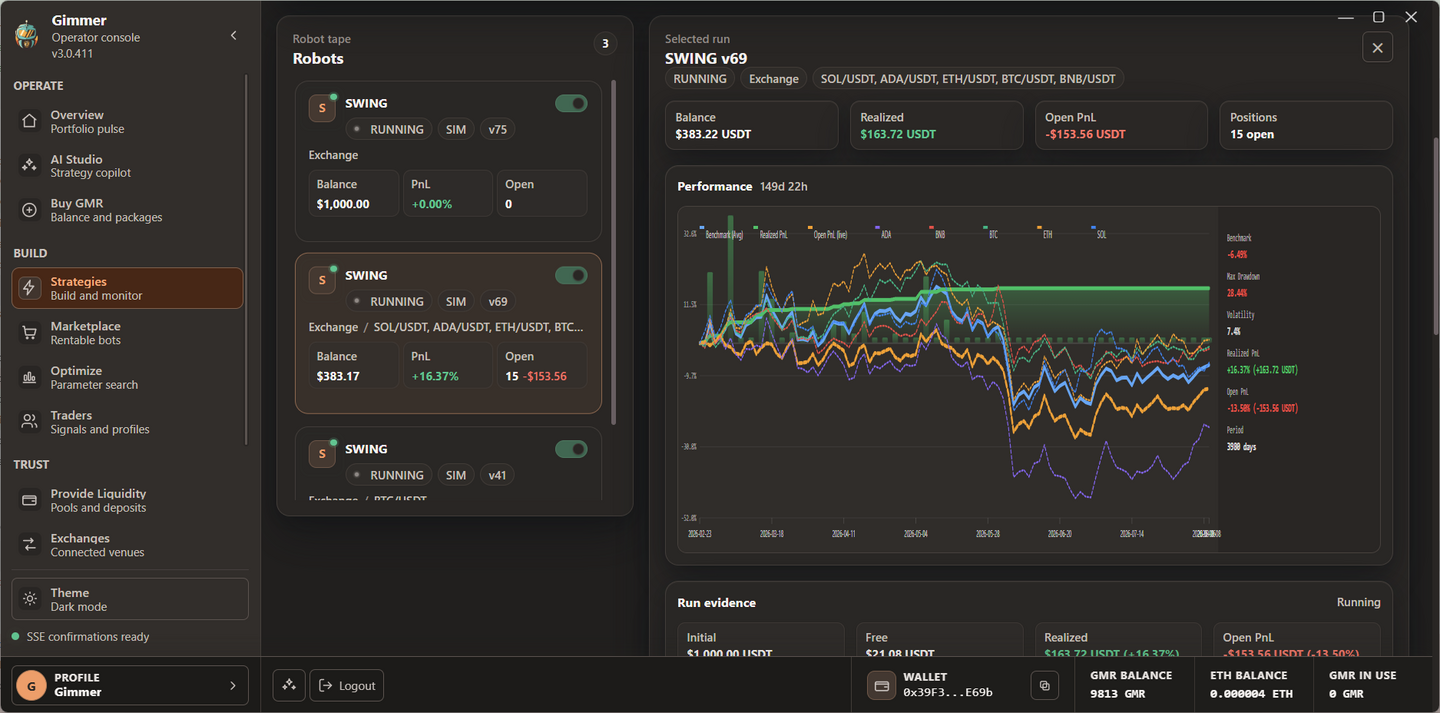
A backtest replays historical candles through the same strategy rules and produces evidence about returns, drawdown, exposure, trades, and order behavior.
Prepare the test
- Save the strategy revision. Record the engine, execution mode, markets, interval, sizing, leverage, and risk settings.
- Choose a meaningful date range. Include rising, falling, sideways, high-volatility, and low-volatility periods where data exists.
- Set the initial balance. Use an amount that is consistent with the position rules and exchange minimums.
- Use realistic costs. Fees, spread, slippage, funding, and borrowing can materially change results.
- Run and wait for a final state. A long search or data download should show progress; a run with no progress or candidates needs diagnosis rather than indefinite waiting.
Read the report as a system
| Measure | What it answers | Common mistake |
|---|---|---|
| Realized PnL | What closed positions earned or lost. | Ignoring large unrealized losses still open. |
| Open PnL | Current unrealized change in open positions. | Treating it as irrelevant until close. |
| Max drawdown | Largest peak-to-trough equity decline, including open exposure. | Comparing a closed-trade-only number with an equity-based number. |
| Win rate | Share of closed trades classified as wins. | Assuming more wins means better expectancy. |
| Trade count | How much historical execution evidence exists. | Trusting a high return from very few trades. |
| Benchmark | How the result compares with passive market movement. | Ignoring the risk and capital differences between series. |
Inspect trades and positions
The Positions area contains open and closed positions and identifies the operation as buy, long, or short. Open the trade replay from that context to inspect market-specific candles and the Execution ledger.
- Confirm that every marker is anchored to the candle matching its execution time.
- Click a marker and verify that the corresponding ledger entry expands and scrolls into view.
- Check that each symbol appears once and that candles and positions are not duplicated.
- Compare entry, exit, amount, PnL, and timestamps with the report.
Validate outside the optimized sample
Keep a later period out of parameter selection, then test the chosen strategy on that unseen range. Compare nearby parameter values and rerun with worse costs. A strategy that collapses after a small input change is less robust than its best historical result suggests.
Backtests are models
Historical candles cannot reproduce every order-book change, network failure, API outage, queue delay, partial fill, liquidation, or human intervention.
Resolve a failed or stalled run
- Confirm that the strategy engine and execution path are supported.
- Check the date range and available candles for every selected market.
- Reduce the optimization search space and confirm that completed candidates begin to appear.
- Open the full backtest page if an embedded marketplace review modal reports an unsupported path.
- Capture the exact error, strategy type, interval, markets, date range, and app version.