
Build / Decision engine
Let AI recommend an action while Gimmer keeps execution governed.
AI Decision sends closed-candle OHLCV evidence to a configured Strategy Studio runtime. The runtime can recommend buy, sell, or hold; Gimmer remains responsible for sizing, risk controls, and order execution.

Configure the decision contract
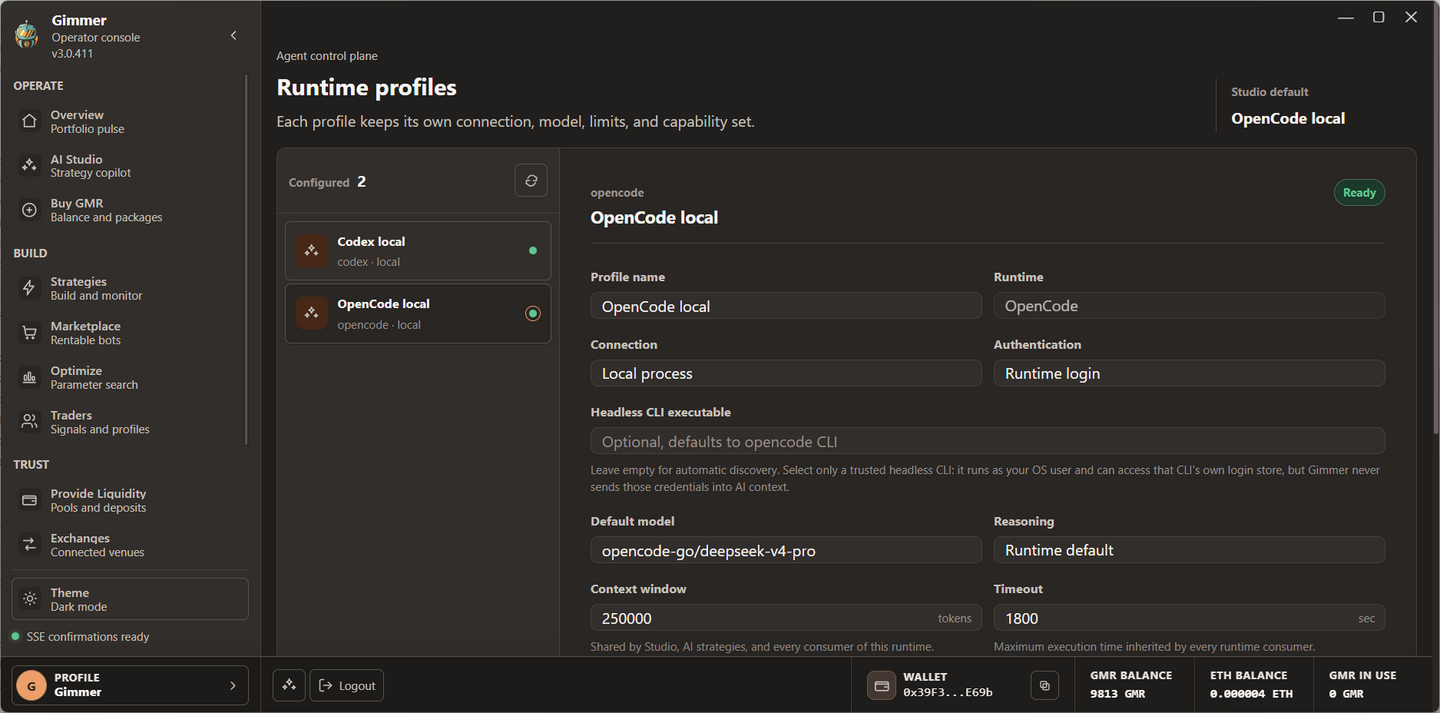
- Select a ready Studio runtime. The builder shows the configured profile that will review the supplied evidence.
- Choose a decision interval. The runtime reviews evidence at the configured closed-candle cadence, not on arbitrary partial candles.
- Set minimum confidence. Recommendations below the threshold become hold decisions instead of orders.
- Write a bounded policy. State what evidence matters, what invalidates a decision, and when the runtime must hold.
- Choose Spot or Margin execution. This controls how an accepted recommendation is executed; it does not change the evidence supplied to the runtime.
Keep evidence inspectable
The primary evidence is the OHLCV history supplied by Gimmer for the configured exchange, market, and interval. Optional public prediction evidence can add context when enabled, but it must never replace the replay clock or introduce unavailable facts into a historical backtest.
Review the runtime decision history after a backtest or simulation. A recommendation should preserve its timestamp, action, confidence, and supporting explanation so an unexpected trade can be traced to the exact closed candle.
Failure must become hold
A model response is not an execution guarantee
An unavailable runtime, invalid response, stale evidence, low confidence, or contradictory policy must produce hold. Do not convert a runtime failure into a default buy, sell, long, or short action.
Backtest several market regimes and deliberately test runtime failures. Confirm that Gimmer still applies position sizing, stop loss, trailing behavior, exposure limits, and order validation independently from the recommendation.